How to judge a claim of alien life
Extraordinary claims need a ladder, not a headline. NASA scientists proposed one in 2021.
What counts as a biosignature
A biosignature is any feature that life makes: a fossil shape, a chemical pattern, a gas in a planet’s air that should not last without a source. The trouble is that many of these can also come from geology or chemistry without life. Methane on Mars, for example, could come from microbes or from rocks reacting with water.
A ladder of confidence
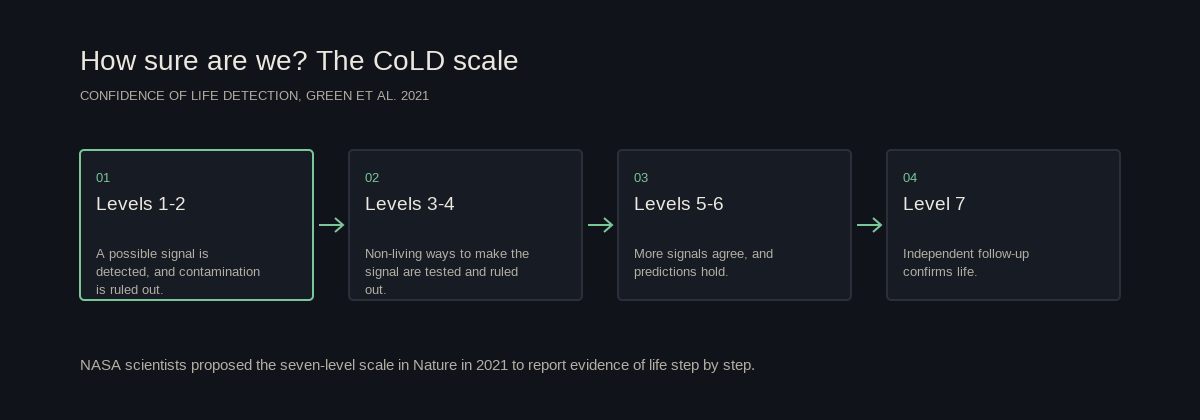
In 2021 NASA scientists led by James Green proposed the Confidence of Life Detection scale in Nature. It has seven levels. Level 1 is detecting a signal that could come from life. The next levels rule out contamination, show the signal could be made by life in that environment, and rule out non-living explanations. Level 7 means independent follow-up confirms it.
The scale is a way to report progress honestly. Most claims so far sit at the bottom rungs.
Recent test cases
In 2020 astronomers reported phosphine in Venus’s clouds, a gas that on Earth comes mostly from life. Reanalysis cut the signal down and the claim remains disputed. In 2025 a team using the James Webb Space Telescope reported possible signs of dimethyl sulfide on the exoplanet K2-18b. Other teams found the evidence weak. Both show the process working: a claim, then checks.
The Mars sample from Cheyava Falls is the strongest case yet, and it too needs more steps.
A habit for readers
When a headline says scientists find signs of alien life, look for the word potential, ask whether non-living causes were ruled out, and wait for a second team. Excitement is fine. So is patience.
Common questions
Has any claim reached level 7?
No. No claim of life beyond Earth has been independently confirmed.
What would count as a technosignature?
A sign of technology, such as a narrow radio signal. SETI searches for these. None has been confirmed.