Where life could hide in the solar system
Life as we know it needs liquid water, energy and the right chemistry. The solar system has more of all three than anyone expected fifty years ago.
The recipe
Every living thing on Earth needs liquid water, a source of energy, and a few elements: carbon, hydrogen, nitrogen, oxygen, phosphorus and sulfur. Astrobiologists look for places with all three. For decades they focused on the habitable zone, the band around a star where a planet’s surface could hold liquid water. Then spacecraft found oceans far outside it, kept liquid by tidal heating deep inside icy moons.
Mars, the fossil hunt
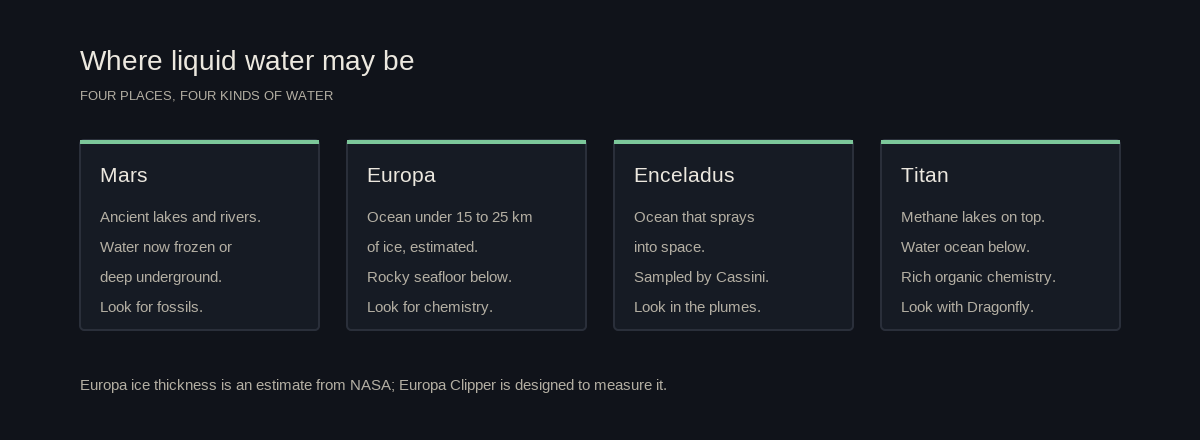
Mars is cold and dry today, but orbiters and rovers have found dry riverbeds, lake deposits and minerals that form only in water. If life started there billions of years ago, traces could survive in rock. NASA’s Perseverance rover is collecting samples from Jezero crater, once a lake, for that reason.
Europa and Enceladus, the hidden oceans
Jupiter’s moon Europa has an ocean of salty water under its ice, likely in contact with a rocky floor, which could supply chemical energy. NASA’s Europa Clipper launched in October 2024 to study it and is due to arrive in 2030. ESA’s JUICE mission is also on its way to Jupiter’s moons.
Saturn’s moon Enceladus makes sampling easy. It sprays its ocean into space through cracks at its south pole. Cassini flew through those plumes and found salts, organic molecules and, in a 2023 study in Nature, phosphates, one of the last missing ingredients.
Titan, the strange one
Titan has rivers and lakes of liquid methane and ethane, a thick nitrogen atmosphere, and a water ocean far below. Life there, if any, could be very unlike ours. NASA’s Dragonfly, a nuclear-powered drone, is scheduled to launch in 2028. Next, see what Perseverance found in the Cheyava Falls rock.
Common questions
Is Venus a candidate?
Its surface is far too hot, but some scientists study its cloud layers, where temperature and pressure are milder. A 2020 claim of phosphine in the clouds remains disputed.
Could life exist without water?
Some researchers think other liquids, such as Titan’s methane, could host very different chemistry. No one has evidence of it yet.